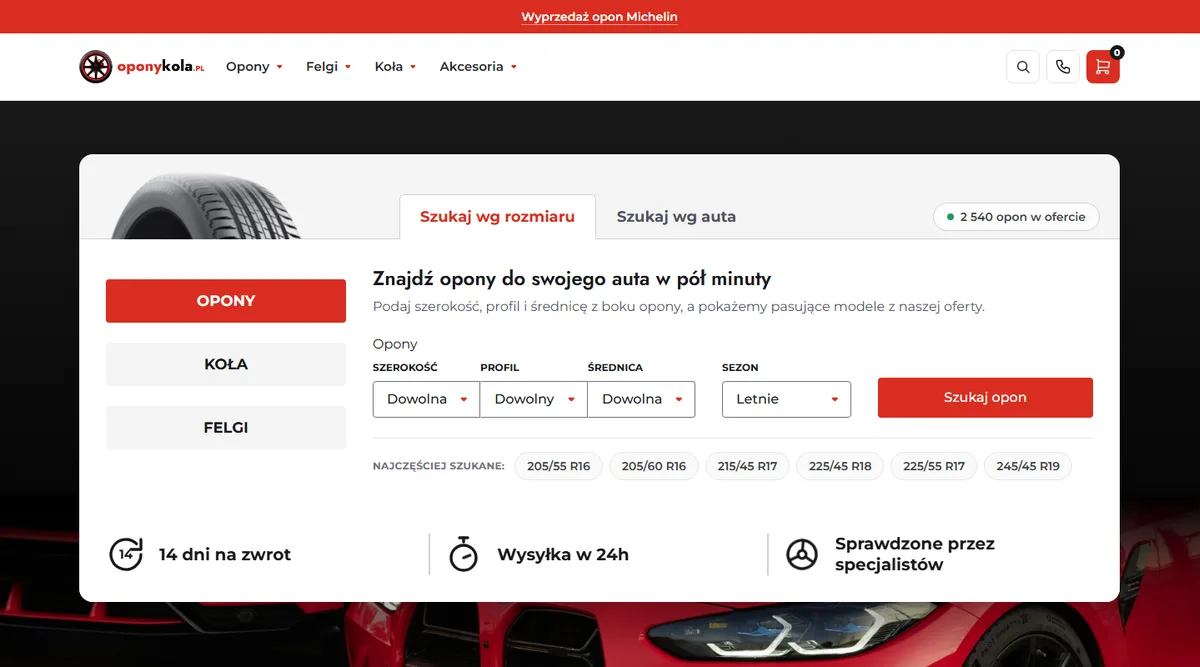
Over five thousand listings and no two the same: every tyre and rim carries its own year, tread depth and casting number, so the catalogue describes items rather than sizes on a shelf. Built on Medusa, with a search that picks wheels by car make and year, and one stock shared with Allegro and OLX.
On every project, a few AI agents work alongside us in parallel, fed with a knowledge base built deployment after deployment. Every result is verified by another agent and every change goes through our code review – we know this technology and architecture inside out, so there is no room for spaghetti code.
We are at the helm – a few AI agents behind us, each under code review.
01
The knowledge base
A vault with hundreds of pages of standards, playbooks and decisions from real deployments. Our institutional memory, not a folder of notes.
02
A few agents at once
Each agent gets that knowledge and its own slice of the project: the pricing module, the ERP integration, tests, SEO. In parallel, not one by one.
03
Logic tailored 1:1
Agents build and test autonomously, but nothing ships unchecked: one agent reviews another, and the final code review is ours. Architecture and quality stay in our hands.
koda › agent orchestration
12+
AI agents working in parallel
100%
of deployment knowledge in one base
Weeks
instead of months to launch
The vault: a knowledge base that connects everything
Every deployment leaves a trace – standards, playbooks, decisions and battle-tested modules land in our vault. AI agents get that knowledge on day one, so no project ever starts from zero.
Click a node to see what it is and what it connects to.
We build solutions for every industry
Every industry has its own rules – from size charts in fashion to pallets in the garden. We are not learning on your project: we have shipped these patterns before.
Kids and toysage categories, bundles and certificates
Food servicewholesale for venues and recurring orders
Fashion and clothingsize charts, variants and lookbooks
Automotivepart fitment by year and model
Kids and toysage categories, bundles and certificates
Food servicewholesale for venues and recurring orders
Fashion and clothingsize charts, variants and lookbooks
Automotivepart fitment by year and model
Kids and toysage categories, bundles and certificates
Food servicewholesale for venues and recurring orders
Fashion and clothingsize charts, variants and lookbooks
Automotivepart fitment by year and model
Health and beautybeauty wholesalers and salon zones
Electronicsspecs, warranties and comparison tools
Food and drinkexpiry dates and cold-chain logistics
Home and gardenpallet shipping and oversized products
Health and beautybeauty wholesalers and salon zones
Electronicsspecs, warranties and comparison tools
Food and drinkexpiry dates and cold-chain logistics
Home and gardenpallet shipping and oversized products
Health and beautybeauty wholesalers and salon zones
Electronicsspecs, warranties and comparison tools
Food and drinkexpiry dates and cold-chain logistics
Home and gardenpallet shipping and oversized products
What can we build for you?
References we actually earned
Our list of reviews grows with every project we hand over. Clients post them on Clutch, an independent platform that rates IT companies.
5.0See all reviewsKoda Plus's average rating on Clutch over the last 12 months is 5.0
Frequently asked questions
What does Koda Plus do?
Koda Plus is a team that builds complete online sales systems: B2B wholesale and e-commerce stores (on Medusa.js, Shopify and Webflow, among others), websites and web applications, graphic design, process automation and SEO and AEO optimisation. All of it in one pair of hands – from the first design through to scaling up.
Where are you based and do you work remotely?
Our office is in Wrocław, and part of the team works from the Tricity area. We deliver projects fully remotely for clients across Poland – communication, meetings and file handover all happen online.
How much does an online store or a website cost?
The quote depends on scope – a landing page is one thing, a large B2B store with integrations is another. We don't impose technologies or packages: after a short, free call we prepare a quote matched to your goal and budget.
What technologies do you build stores and websites on?
We usually build stores on Medusa.js (headless, open-source) and Shopify, and websites on Astro, Next.js and Webflow. We pick the stack for the specific project, so that it gives you full ownership of the code and data, plus fast loading.
Do I get the full code and all the access once the project is finished?
Yes. We hand over the entire source code and every access – they belong to you. We don't lock clients in; you can keep developing the project with us or with any other team.
How long does a project take?
A typical project takes 4 to 8 weeks, depending on complexity. Simpler websites are ready sooner, while larger stores with ERP, payment and logistics integrations take longer. We agree the timeline at the start and communicate progress at every stage.
How is Medusa.js different from Shopify and WooCommerce?
Medusa.js is headless open source: no licence fees or platform commissions, full code ownership and any B2B logic you need – per-customer price lists, VAT-ID registration, quick ordering. Shopify wins on a fast start in simple B2C but limits customisation and adds fixed fees, while WooCommerce tends to grow into dozens of plugins. That is why we build wholesale and non-standard flows on Medusa.
Which integrations do you support?
ERP and accounting (Subiekt GT, Comarch Optima, Fakturownia), logistics (InPost ShipX, couriers), marketplaces (Allegro – directly via API or through BaseLinker), payments (Przelewy24, Stripe) and KSeF e-invoicing. We also build dedicated integrations for the system you already run.
Do you prepare stores for KSeF e-invoicing?
Yes. Poland's National e-Invoicing System becomes mandatory in February 2026 for the largest companies, April 2026 for other VAT payers and January 2027 for the smallest businesses. We integrate issuing and receiving e-invoices directly into the order flow of your store or wholesale platform.
How do your AI agents work and is the code safe?
A few AI agents work on the project in parallel, fed from our knowledge base, but nothing ships unchecked: one agent verifies another and the final code review is ours. Dedicated security agents audit the code and infrastructure at every stage – the architecture stays in our hands.
What does the process look like from first contact to project kickoff?
We start with a free online call to understand the scope, the integrations you need and your deadline. You then get a quote broken down into stages along with a schedule – once you accept it, we sign the contract and set a start date. Throughout the project your point of contact is one of the founders, Remigiusz or Adrian – nothing gets handed off to an account manager. We work in Polish and English.
What does the contract cover and how are stages settled?
The contract covers scope, schedule, stage-based payments and the transfer of the economic copyright in the code to you, together with the fields of exploitation – Polish copyright law requires these to be listed explicitly and the contract itself to be in writing. We arrange the stages so you can see what you are paying for and in what order features get built. If the scope changes mid-project, we agree it separately before the work starts – not afterwards on an invoice.
What if I already have an in-house team or an agency – can you work alongside them?
Yes. We can take one specific area: the Medusa.js backend, an ERP integration, the frontend or automations, and work inside your repository, code review process and ticket system. We can also audit your existing codebase and hand over recommendations instead of rewriting everything from scratch. We agree on who owns what at the start, so nothing gets duplicated and deployments don't block each other.
What happens after launch – do you maintain the store, and is there an SLA?
After launch you can stay on a maintenance plan: monitoring, updates, fixes and further development. SLA terms and response times are agreed case by case, because a B2B wholesale platform running on ERP integrations needs something different from a company website. If your own team takes over, we run a full handover: documentation, environments and a walkthrough session for your developers.
Can a B2B wholesale store have individual price lists for each customer?
Yes – Medusa.js handles customer groups with their own price lists out of the box, and on top of that you can layer negotiated prices for a specific company plus quantity breaks. We usually sync price lists from the ERP so your sales team doesn't maintain them in two places. A logged-in buyer sees only their own terms, while guests see list prices or none at all – that's a business decision, not a technical limit.
How does company registration by tax ID and buyer verification work in a B2B store?
The signup form pulls company details from the official business register by tax ID (in Poland: the free GUS / REGON API), so the buyer doesn't retype a name and address from an invoice. VAT status is checked in the system that fits the transaction: the Ministry of Finance register for Polish companies, VIES for EU counterparties – two different tools for two different cases. New accounts go into moderation: until an account manager approves the company and assigns a price group, the buyer doesn't see wholesale prices. It's worth storing the VIES reply against the account together with its consultation number, because a valid EU VAT number provided by the buyer is a condition for zero-rating an intra-EU supply, not merely good practice.
Can a B2B store handle credit limits and deferred payment terms?
Yes – each company account gets a credit limit and payment terms (say net 30), and at checkout the system checks available balance and overdue invoices. Medusa.js ships with cart approvals and per-employee spending limits; the trade credit limit and the balance we add on top, since that data lives in the ERP. Once the limit is exceeded, the cart can be blocked, routed to an account manager for approval, or offered prepayment – we shape that logic around your process. Balances and settlements stay in the ERP, so the store queries them through an integration instead of keeping a second version of the truth.
Can you run wholesale and retail sales from a single store?
Yes – a single Medusa.js installation serves both channels: the same catalogue and stock, with different pricing, order minimums and presentation depending on whether the buyer is logged in as a company or shopping retail (that's what sales channels are for). Wholesale customers get net prices, MOQs and case packs (the cart rounds up to a full carton), retail customers get gross prices and a standard cart. Quick-order by SKU or EAN from a pasted list or a CSV upload is something we build on top of the cart. Alternatively we build two frontends on a shared backend if the brands need to look distinct.
Is Medusa.js production-ready, and who is behind the project?
Medusa is an MIT-licensed open source e-commerce backend built in Node.js and TypeScript, developed by the Danish company Medusa (Medusa Commerce ApS, Copenhagen) together with its GitHub community, with regular releases and a commercial cloud offering, Medusa Cloud. Version 2.0 has been stable since October 2024 and runs in production in stores and B2B wholesale platforms, from small builds to large brands, and its modular architecture lets you add custom logic instead of working around platform limits. The "vendor disappears" risk is lower than with SaaS: you hold the code and the data, and the MIT license lets you keep maintaining the project even if its direction were to change. When choosing a stack we always discuss the exit path and long-term maintenance as well.
Headless or a traditional store – what's the difference and which should I choose?
In a traditional store (WooCommerce, PrestaShop) the backend and the storefront are fused – you launch faster, but every non-standard change ends in overriding templates and plugins. In headless the frontend is a separate app talking to the backend over an API: any design you want, one backend serving the store, a B2B portal and a mobile app, and performance is easier to optimise because the frontend is served statically from a CDN. The trade-off is complexity: two deployments, more work upfront and maintaining both layers separately. Headless makes sense when you have non-standard processes, ERP integrations or more than one sales channel; for a simple off-the-shelf store it can be overkill – and we will say so.
How much does it cost to run an open source store, and where should it be hosted?
There are no license fees or revenue-share commissions on the software itself – your cost is hosting, the database and maintenance, so it does not automatically grow with order volume the way it can with SaaS. We host the frontend on Cloudflare or Vercel, and the backend and database on a server or in the cloud (VPS, container, managed PostgreSQL, plus Redis and file storage). On top of that come updates, monitoring and further development – scoped individually. We quote hosting only once traffic and catalogue size are known, because the gap between a small store and a wholesaler with thousands of SKUs is significant.
Can I move my store off WooCommerce or PrestaShop without losing Google rankings?
Yes, provided the migration is planned before the build, not after. The essentials: a 301 redirect map from every old URL to the new one for products, categories and posts, keeping the URL structure where possible, carrying over titles, meta descriptions and structured data, and preparing a new sitemap. After launch we watch Google Search Console for 404s and drops so we can react in the first weeks. Short-term ranking fluctuations do happen when changing platforms and nobody can guarantee a timeline – but with correct redirects and a faster frontend, traffic usually recovers within a few weeks.
What is AEO and is it worth optimizing a store for ChatGPT and AI search?
AEO (Answer Engine Optimization) means structuring content so AI models – ChatGPT, Perplexity, Gemini, Google's AI Overviews and AI Mode – can quote it correctly and credit the source. In practice: a clean heading structure, schema.org structured data (Product, Organization, BreadcrumbList), direct answers instead of filler, and fast server-rendered HTML that doesn't need JavaScript to display its content. We do this alongside classic SEO because the foundations overlap, and traffic from AI assistants is growing fast – Adobe's Q1 2026 data showed it converting better than non-AI traffic. It's also worth checking that robots.txt or CDN rules aren't blocking the search crawlers (OAI-SearchBot, PerplexityBot) – those are the ones behind citations, not the model-training bots.
How long does it take to see SEO results for a new online store?
The first technical wins – indexing, Core Web Vitals improvements (LCP, INP, CLS), long-tail traffic – usually show up within a few weeks of launch. Meaningful growth in traffic and sales on competitive keywords takes quarters: Google needs time to gather signals about a new domain, and content and links have to accumulate. A brand-new domain ramps up slower than a migration of an existing store – with 301 redirects done properly, rankings usually recover within weeks. We don't promise specific positions, because nobody honestly can – instead we set measurable goals in Search Console and analytics.
Do you run Google Ads campaigns and sell on marketplaces like Allegro?
We focus on the technical and data layer rather than day-to-day campaign management – we're not a media agency. We handle what makes ads work: the product feed for Google Merchant Center, correct event tagging, integration with Allegro and other marketplaces via API (syncing listings, stock levels and orders into one panel), and store-side automation. If you have your own Ads specialist, they get a clean feed and working tracking from us; if you don't, we can recommend partners we trust.
How do you measure sales and know which channels actually make money?
As standard we set up GA4 with e-commerce events (view_item, add_to_cart, begin_checkout, purchase), Google Tag Manager and Search Console, and for higher-traffic stores server-side tracking so data isn't lost to blockers and browser restrictions. On top of that comes a consent banner with Consent Mode v2 – required in the EU if you use Google ads and remarketing, and without it your data is incomplete. Because Medusa is open source and the order database is yours, we can build margin and true channel-profitability reports you simply can't get on a closed platform. We agree the scope up front – not every store needs the full analytics stack from day one.
Free 15-minute call
Tell us about your project, we'll tailor the rest to you
A 15-minute call is enough for us to know whether we are a fit for your project. We start from what you need, not from an off-the-shelf solution.