
The packaging ladder
in Medusa
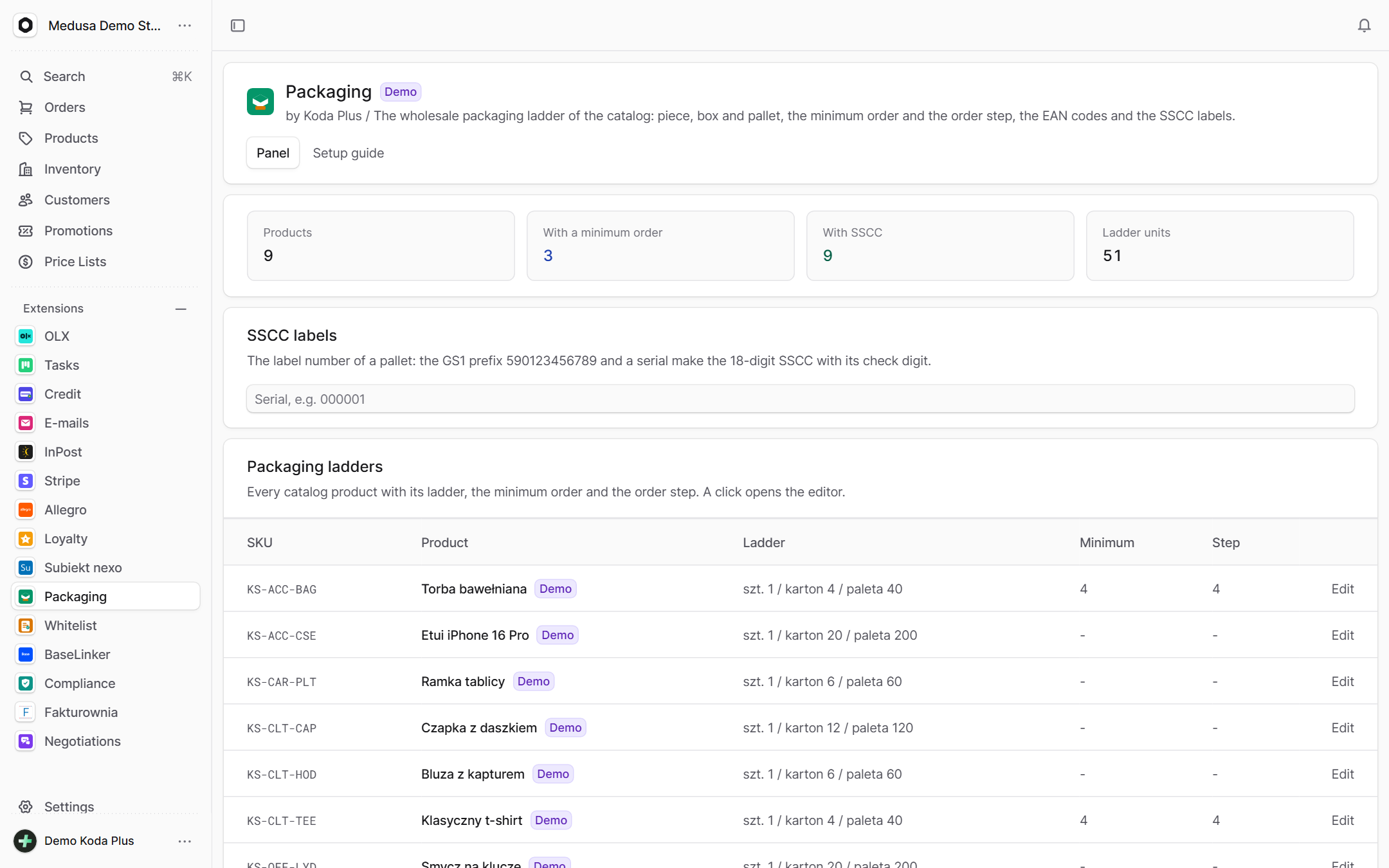
The wholesale packaging ladder of the catalog, right where the store is run: the piece, the box and the pallet of every product, the minimum order quantity and the order step, the EAN codes and the SSCC labels for pallets. A wholesaler sells in units, not pieces: twelve drills in a box, one hundred and twenty on a pallet, and nobody orders eleven.
What exactly
this integration does
-
A ladder per product
The piece, the box and the pallet, each with how many pieces fit into it, the box EAN and the pallet SSCC prefix. An editor in the admin, in English and Polish.
-
Minimum and step
The MOQ in pieces and the order step, so an order below or between rungs can be refused or rounded – instead of packing eleven drills.
-
SSCC labels
The SSCC tool turns a serial into the 18-digit pallet number, its human grouping and the GS1-128 payload, with the check digit computed by the GS1 rule.
-
The ladder next to the price
The store API serves the ladder of an offer, so the product page shows it next to the price – no separate price list to keep in sync.
-
A counter for gaps
The koda.integration/1 contract counts products without a ladder and shows it on the product page, so nothing slips through.
-
Demo mode
Sample ladders flagged demo, to see the admin on showcase data before you fill the catalog.
How it guards
your data
-
One ladder per product
A write is an upsert per product: the new version replaces the old in one operation, with no duplicated rungs.
-
The check digit is computed
An SSCC is built from the prefix and the serial, and the check digit is computed by the GS1 rule – there is no place for a human error.
-
Sample data kept apart
Demo ladders never touch the real rows of the catalog.
Setup
in three steps
The full list of options, events and API routes is in the package README on GitHub.
Paste it into Claude Code, Cursor or another AI assistant in your Medusa project: it installs and configures the integration, with writes off.
- 1 Install the package from npm.
npm install @koda-plus/medusa-plugin-packaging - 2 Add the plugin to medusa-config.ts.
plugins: [ { resolve: "@koda-plus/medusa-plugin-packaging", options: { // Everything is optional. gs1Prefix: "590123456789", // demo: process.env.PACKAGING_DEMO === "true", }, }, ] - 3 Run the migrations and open the integration in the Medusa admin.
npx medusa db:migrate
Running for our clients
See our portfolio

Other
integrations
- Allegro Offers, orders, stock and parcels
- BaseLinker Cards, stock, prices and orders both ways
- Subiekt nexo Orders as ZK, WZ and invoices with KSeF
- Fakturownia Invoices, corrections and KSeF exactly once
- InPost Parcel lockers, courier and COD on ShipX
- OLX Adverts that match the store's stock
- Stripe Volume, fees, disputes and account health
- Negotiations Target price, counter offer, acceptance
- Trade credit Limits, terms and customer balances
- Loyalty Points, a reward ladder and a ledger
- EU compliance GPSR, RODO and Omnibus in one panel
- VAT whitelist NIP, VIES and REGON in one panel
- E-mails Ready templates in Polish and English
- Tasks Tasks on orders, products and customers
Tell us about your project,
we'll tailor the rest to you
A 15-minute call is enough for us to know whether we are a fit for your project.
We start from what you need, not from an off-the-shelf solution.